When Buying a Pair of Tires
It's best to replace all of a vehicle's tires at the same time. Having the same tread design and tread depth promotes balanced traction and handling.
However if only a pair of tires is replaced, the two new tires are to be installed on the rear axle with the partially worn tires on the front. This is done to reduce the likelihood of drivers losing vehicle control when tires hydroplane on wet roads.
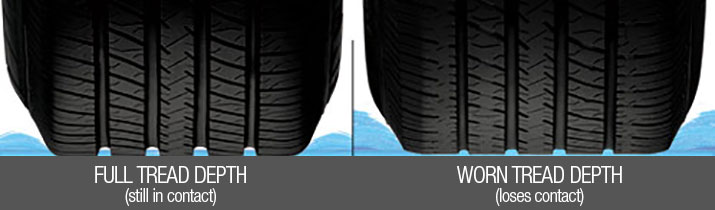
Hydroplaning can occur when driving through rainstorms or standing water. If water can't flow from under a tire's tread pattern, it can lift the tread until it loses contact with the road. Tires with less tread depth will hydroplane in shallower water and at lower speeds than tires with deeper treads.
Whether the front or rear tires hydroplane first can make all the difference.
Hydroplaning front tires promote understeer, a condition in which a vehicle continues forward. Most drivers' natural instinct to lift off the throttle causes an understeering vehicle to slow and helps the front tires regain traction.
Hydroplaning rear tires promote oversteer, a condition that reduces vehicle stability. If rear tire hydroplaning causes a vehicle to oversteer, lifting off the throttle will further reduce stability, possibly causing the rear of the vehicle to slide, fishtail or spin.
It's easier for drivers to control understeer; whereas trying to neutralize oversteer is far more challenging. It's better to sacrifice some grip up front rather than at the back.
When installing a pair of new tires instead of four, Tire Rack's policy is to make sure the new tires are appropriately sized and compatible with the performance category of the current tires. The pair of new tires will then be installed on the vehicle's rear axle.
Notes: Applies to front-, rear- and all-wheel drive vehicles. Some all-wheel drive vehicles also require matching tire tread depths to prevent driveline damage.
Minor differences in tread depths between front and rear tires (up to 2/32") are allowable and permit rotating tires.

 Orders