Use our Tire Service/Maintenance Record (PDF) to log tire rotations, seasonal tire changeovers and tire-related vehicle services. This type of record is often helpful if warranty consideration is ever necessary.
We all hear that tire rotation is important, but why? How often should you do it? HOW do you do it?
Using tire rotation as preventative maintenance will help ensure your tires wear evenly, both front-to-back and side-to-side. This helps enhance wear quality and prevent an increase in pattern noise. And if you have a minor 1/32"-2/32" difference in front-to-rear tread depth, don't let that stop you from rotating due to concerns in hydroplaning balance. The small difference is unlikely to upset the balance between the front and rear axles, so make a note of it, and remember that any differences in wear rates actually indicate that tire rotations should be done more frequently.
Tires on the front and rear axles perform very different tasks, and rotating tires every 3,000-5,000 miles (or more frequently for tires with aggressive, all-terrain or off-road-focused patterns) allows each tire to spend time at each wheel position on the vehicle. “Spreading the work” of each wheel position amongst all the tires helps to keep the wear even, maintaining the vehicle's proper handling balance and helping to ensure any tire tread life warranty remains valid.
Additionally, if your tires wear out as a set, you can replace them all at the same time, allowing you to switch to a more modern, likely improved, product, instead of being forced to match the existing pair that hasn't yet worn out.
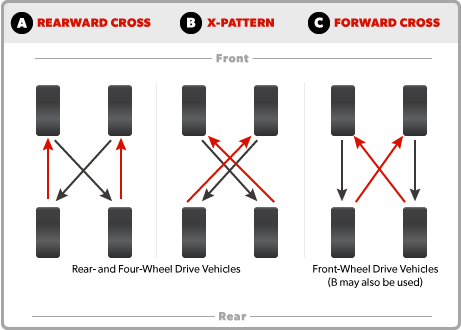
Tires should be serviced periodically following the rotation patterns provided in the vehicle's owner's manual or as established by the tire industry, so if your vehicle doesn't have rotation instructions in the owner's manual, the diagrams below can be your guide.
Four (4) Tire Rotation
The Tire & Rim Association suggests three rotation patterns covering most vehicles (equipped with non-directional tires and wheels of the same size and offset). The first is the "Rearward Cross" (Figure A); the second is the "Forward Cross" (Figure C); and the third is the "X-Pattern" (Figure B). The X-Pattern can be used as an alternative to A or C.
Today's performance tires and wheel trends have provided the need for two additional tire rotation patterns.
The "Front-to-Rear" (Figure D) pattern may be used for vehicles equipped with the same size directional wheels and/or directional tires.
A "Side-to-Side" (Figure E) pattern may be used for vehicles equipped with different sized non-directional tires and wheels on the front axle compared to the rear axle.
If the last two rotation patterns do not provide even wear, dismounting, mounting and re-balancing will be necessary to rotate the tires.
Vehicles that use different sized directional wheels and tires, and/or wheels with different front and rear offsets with directional tires will require dismounting, mounting and re-balancing to rotate tires.
Five (5) Tire Rotation
Most of the time, you'll find your vehicle has a compact, temporary spare (or none at all) that can't be included in a tire rotation program. However, if your vehicle's four wheels and tires on the ground match the spare wheel and tire (if non-directional and not branded "for temporary use"), you should include it in your rotations. Once again, follow the vehicle manufacturer's recommended tire rotation procedures, or if not available, insert the spare in the right rear position at every rotation. Put the tire that would have gone to the right rear in the trunk as the spare until the next tire rotation
On front-wheel drive cars with full-size matching spare, rotate the tires in a forward cross pattern (Figure F)
On rear-wheel or four-wheel drive cars with full-size matching spare, rotate the tires in a rearward cross pattern (Figure G)
When you include all five tires in your rotation, the use (and therefore the wear) will be evenly distributed, so all five tires should maintain equivalent tread depths. This helps "extend" the life of all five tires, plus it wears out the spare tire before it "ages out," ensuring it is safe for use when needed. Plus, if you have a four-wheel drive or all-wheel drive vehicle, it prevents damage to the driveline by ensuring a brand new spare isn't put into service with partially-worn tires in the other three wheel positions.
Six (6) Tire Rotation
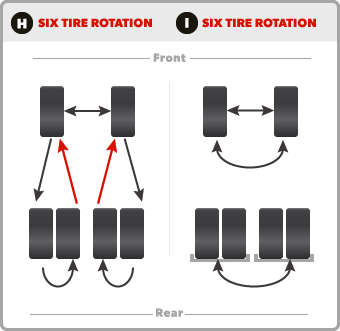
You can rotate the tires on your dual rear wheel truck, too, though be careful because many use different tire sizes and/or wheels on the front versus the rear axle. Vehicles with dual rear wheels and non-directional tires of the same type and size in all six wheel positions may use the rotation pattern in Figure H or Figure I, keeping in mind the wear pattern and wear rate of dual rears are sensitive to significant differences in tread depth within the pair. If the vehicle has tires of a different type and/or size on the front and rear axles, they should only use the rotation pattern depicted in Figure I, rotating across the axle side-to-side, but not front-to-rear
Studded Winter / Snow Tire Rotation
Studded tires should also be rotated periodically to ensure the best possible wintertime performance and longest service life. Rotation helps all four tires maintain equivalent wear throughout their life, which helps balance traction levels and handling characteristics, as well as allowing drivers to get more life out of their set of four tires.
Tire Rack recommends rotating studded tires at the beginning of every winter season or every 4,000 miles, whichever comes first.
The rolling direction of studded tires should never be changed.
This can be achieved by rotating tires from front to rear on the same side of the vehicle.
It is also permitted to remount the tires inside-out on the wheels to allow them to be used on other side of the vehicle if uneven wear due to camber is detected.
With over 10,000 approved and trusted installers across America, you’re in excellent hands.
World-Class Customer Care
Need help? You’ll reach a U.S.-based team whose expert guidance helps drive Tire Rack’s Net Promoter Score of 86.5*, well above the 80+ benchmark for “world‑class.”
*May 2026
Revolutionizing Tire Buying Since 1979
From our first location to launching nationwide mail order to creating TireRack.com, we believe in bringing you The Way Tire Buying Should Be.™
Independent Tire Testing Program
We test tires on the road and on our specially designed track to simulate real-world dry and wet conditions. Independent, unbiased results to help inform your choice.
Real Drivers. Real Miles. Real Talk.
Tire Rack verified customer reviews come backed by over 3.4 billion real-world miles.
Need help choosing the right products for your vehicle? Our US-based team of highly trained experts has the knowledge and passion to help. Just pick up the phone and give us a ring. Or let's chat via email. We love solving problems and lending a hand (or an ear).

 Orders